|
On the fourth day of the Atmosphere conference I left campus and walked to the Museum of Anthropology. I had been talking to people for three days straight and needed to think at a different tempo.
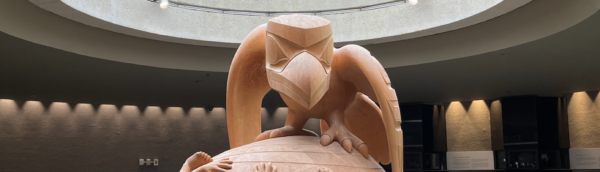
The museum sits at the edge of UBC's campus, a brutalist concrete structure half-hidden in cedars. You walk through a low corridor of carved figures and bentwood boxes and then the space opens into the Great Hall, where the ceiling rises to meet a wall of glass some dozen metres high. Through it you can see the treeline and, beyond that, the grey water of the strait. Monumental cedar poles stand throughout the hall, some painted in the black and red formline style, others weathered to a pale silver, their carved figures softened by decades of exposure before being brought indoors. The light was overcast the day I visited, and the poles seemed to glow against it.
The oldest poles were brought from Haida village sites on Haida Gwaii. One display describes K'uuna Llnagaay, a village that at its height contained twenty-six houses and more than fifty monumental poles standing together above the shore. By the 1880s a series of smallpox epidemics had devastated the population and the survivors had consolidated into other settlements, and the village emptied, and the poles remained. Eventually some were brought here. In the traditional system, cedar poles are impermanent; they lasted decades rather than centuries, and when they finally decayed a new pole would be raised in a ceremony whose purpose was to reaffirm the claims the old one had carried into the world. What the museum preserves, in its climate-controlled concrete hall, is something that was designed from the beginning to be replaced.
Nearby, the hall is filled with feast dishes: massive carved bowls shaped into the forms of sea creatures, some large enough to hold food for hundreds of guests at a potlatch. These are spectacular objects, and it would be easy to stand before them and see nothing more than art. The museum panels push against this reading, and explain a potlatch, as the central institution of Northwest Coast governance. Hereditary chiefs would publicly declare their rights, their names, and their territorial claims before invited witnesses, who were feasted and compensated for the labour of carrying what they had witnessed back into the world as living memory. The feast dishes held the food that paid the witnesses. One panel describes Nisga'a succession: when a chief passes, the eldest maternal heir inherits the role, and with it the name, the regalia, the territorial title. The transfer is law because hundreds of people were there to see it happen. In contrast, a nearby display places a carved figure alongside a framed copy of the Indian Act, the federal law that banned the potlatch from 1885 to 1951.
Elsewhere in the exhibition, a panel titled "Reclaiming Connections" carries a quote from Kwakwaka'wakw artist and scholar Marianne Nicolson:
"The original intention for many of our ancestral objects was directly connected to ceremony, place, and land. They represent certain rights and act as legal documents. So, if they are reduced to simply being beautiful things, then their meaning changes - and they are no longer speaking for us. We need to reconnect these objects and their meanings to our political actions."
I stood in the Great Hall for a long time, longer than I had planned. The poles rose in their controlled atmosphere, preserved indefinitely in a building designed to outlast them many times over, objects made for a system that treated permanence as a failure of renewal.
Hold Fast
The opening keynote of the conference was delivered by Erin Kissane, noted kelp enthusiast and one of the sharpest thinkers working on the question of what our digital infrastructure is actually doing to us. (I choose to believe that these two facts are causally related.) Her talk was called "Landslide / Hold Fast," and it traced a line from the 1964 Alaska earthquake, in which a saturated substrate turned to liquid under repeated shocks and an entire harbour slid bodily into the sea, to our present information landscape, where she argued that something structurally analogous is underway. The knowledge institutions that once functioned as solid ground beneath public discourse have been hollowed out from within and flooded with noise, and the ground has not stopped moving.
Her prescription drew on kelp biology. Kelp holdfasts, the root-like structures that anchor kelp to the seabed, do three things: they anchor entire communities into stability, they create calmer zones within turbulent currents, and they provide shelter for hundreds of species that could not survive in the open water. She asked the room to think about building these properties into protocol-level infrastructure. Not as aftermarket fixes bolted onto existing platforms, but as foundational design choices: systems that integrate real knowledge rather than just circulating links, that offer cognitive and emotional shelter from the relentless puree of jokes and war crimes and memes, and that give communities structural protection so they do not have to constantly defend territory on the open plain.
She described kelp as a foundation species: organisms that evolved long before the communities that now depend on them, whose presence bent the shape of the future around themselves in ways that we now find beautiful and difficult to imagine having ever been otherwise. The implication for the room was not subtle. The atmosphere has a window, perhaps a narrow one, to become that kind of foundation, to build infrastructure whose affordances will shape what becomes possible for communities that do not yet exist and cannot yet advocate for themselves.
It also left me with a question that I kept turning over for the rest of the conference. What is the holdfast in this ecosystem, right now? Is it the protocol itself? Is it Bluesky, the company that built the protocol and runs its dominant application? Is it the community of independent developers building tools on top of it? Is it the social bonds between all the people in the room? These are not the same thing, and they do not always pull in the same direction.
Joy
The most striking thing about the Atmosphere Conference was the emotional register of the event itself. This was a joyful gathering, in a way that is genuinely unusual for a technology conference.
Black and queer communities are a core part of the atproto ecosystem; they are among its most active builders, and the conference reflected this. Blacksky, the Black community on Bluesky that has built its own moderation infrastructure, safety team, and cultural space on the protocol, was well represented, as was a broader queer community whose members include many of the developers and designers shaping the tools people actually use. The afterparty, sponsored by Cloudflare, was held at a drag bar with a live drag show, which is not a sentence you expect to write about a protocol conference but which made perfect sense at this one. The whole event felt like a space where people could be fully present in a way that most professional contexts do not allow for, and this mattered most for the people who have the least access to that experience elsewhere.
In the days after the conference, the people who build and maintain these communities said, separately and in their own words, that it was among the best experiences of their lives: the happiest they had felt, the most valued, the most seen. Emelia Smith, a long-time open protocol contributor who attended remotely, wrote a blog post titled 'On Being Valued,' describing how the shout-outs she received during talks made her realize she had finally found the right room, 'even if I'm not even physically there.
These are not the reactions that people have to technology conferences. These are the reactions that people have to finding a place where they are allowed to exist without apology. Minority communities tend to function as bellwethers for the health of digital ecosystems, because they are the first to feel when a platform turns hostile and the first to feel when one is genuinely safe. When Black and queer people describe a protocol ecosystem gathering as one of the best experiences of their lives, that is a signal about what kind of social infrastructure is actually being built underneath the software.
The conference was also a demonstration of something Erin Kissane identified in her keynote. Online, even sympathetic communities process their commitments through feeds that merge every emotional register into a single stream, and the result is a kind of numbness that forecloses both deep joy and deep engagement. The conference stripped that away. For four days, it was just people thinking together about infrastructure they believed in, in a room where the emotional bandwidth wasn't being competed for by the rest of the internet.
Subculture
I have been telling people for some time now that the atmosphere functions as a subculture, and the conference made this visible in a way that no amount of online interaction could. Everyone knows everyone, and everyone knows that everyone knows everyone, and the social graph is dense and tangled and interconnected in the way you find in scenes, movements and artistic circles, not in industries. The subculture label accounts for both the extraordinary warmth of the conference and some of the frictions online that followed in the days after. Dense social networks with high emotional investment and a shared sense of identity reliably produce intense belonging, and they reliably produce intense conflict when those bonds are placed under stress, and there is no version of these networks that produces one without the other.
What distinguishes the atmosphere most sharply from a classical subculture is the structural position of Bluesky at its centre. Subcultures normally either lack an institutional core entirely or define themselves in conscious opposition to one. The atproto ecosystem has a venture-funded company with well over a hundred million dollars in investment that is simultaneously the primary developer of the protocol, the operator of its dominant application, and a participant in the community whose norms and affections it shares. This is an unusual arrangement that creates a continuous tension. People within Bluesky itself have spoken of the company as walking a fine line between genuine community membership and the slight antagonism needed to push developers toward actually building independent infrastructure on the protocol rather than waiting for Bluesky to build it for them.
We Can Just Do Things
"We can just do things" was the slogan of the conference, printed on the official tshirts. It captured some of the dynamics of the atmosphere: the protocol is open, the tools are available, the ecosystem is welcoming, and the barrier between having an idea and building it is low.
During the conference, in a keynote slot that had been specially cleared so that no other sessions would compete for the audience, Bluesky announced attie, a new AI-powered feed creation tool. The tool allows users to describe the kind of feed they want in natural language and have it generated automatically.
It also directly competes with Graze, an independent startup that had built a custom feed creation tool on atproto and that was a sponsor of the conference. The developers behind Graze had invested time and money into building on the open protocol, had supported the conference financially, and now found themselves watching the protocol's primary developer announce a competing product to the entire gathered community. The term of art is "sherlocking": when a platform incorporates the functionality of a third-party tool, making the independent version redundant.
"We can just do things" means something different depending on who is saying it. When spoken by an independent developer, it describes the freedom to build on an open protocol without asking permission. When enacted by a venture-funded company that controls the dominant application, it describes the same freedom, but with a power differential that changes the meaning entirely. Both uses are technically correct, and both are expressions of what an open protocol makes possible. But one of them puts the holdfast in tension with the organisms sheltering in it.
This is a story about a structural position for Bluesky that is probably irreducibly difficult to occupy well. The atmosphere is a subculture with a corporation at its centre, and the corporation is simultaneously the foundation species that makes the ecosystem possible and a commercial entity that must grow its product to survive. When those two imperatives align, as they did for most of the conference, the result is the extraordinary generative energy that everyone in the room could feel. When they diverge, as they did in the days that followed, the result is friction of the kind that cuts close to the bone.
The conference high and the post-conference tension are not contradictory phenomena. They are two expressions of the same underlying structure, viewed from different angles. The density of the bonds is what makes the joy so intense, and the density of the bonds is what makes the friction cut so deep. A professional network absorbs a product launch and moves on. A subculture receives it as a question about whose work is valued and whether the ground beneath their feet is truly solid.
|